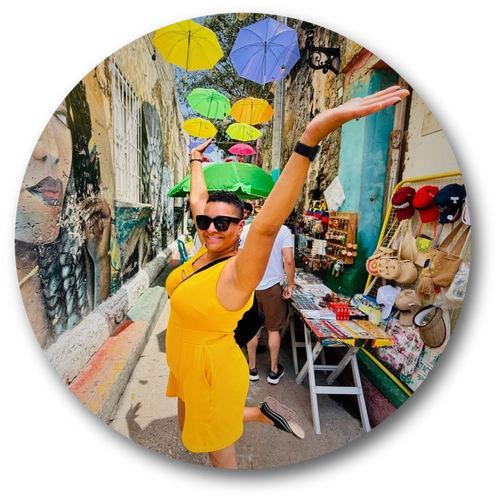
Hello! 👋🏽 I’m Karena.
Bio
As a biracial, Queer, cisgender, “formally” educated, English-speaking, able-bodied person born and raised in the South with citizenship in two countries, I’m well aware of my spectrum of experiences with privilege and power. My call to liberation began before I had language for it. I vividly remember a time somewhere between 4 and 6 years old, where my white, immigrant mother had to explain to me why a neighborhood kid was going up and down our fence singing, “N**ger, n**ger, n**ger.”
It goes without saying, I learned early that the people and systems meant to help people heal were often the same systems causing harm. Because of this, I knew from a young age (13) that I wanted to go into a “helping profession” and I decided that would not be the kind of practitioner I became.
During high school, it became clear to me that I wanted to be a mental health counselor. I had an incredible Psychology 101 and 102 teach who became a mentor to me. She asked me to get an undergraduate degree in Psychology and report back. I did just that. From there, she asked me to investigate counseling, psychology, social work and the varied degree paths – PhDs, PsyDs, M.Eds., etc. I thought long and hard about the path to take and decided that since my family could have desperately used a family counselor, I would get a master’s degree in Marriage, Couple, and Family Counseling.
After my own up-close and personal experience with violence at 19 years old, I wasn’t sure if my overall journey towards becoming a counselor would happen. But fast forward and here I was, a master’s-level intern at Transitions Family Violence Services in Hampton, Virginia, sitting with survivors. I got to work with teens in a group setting who experiences violence in their homes, I worked with people who survived horrific events at the hands of their partners. I cataloged police reports related to violence, so we could track data and publish research. I wrote about relationship violence and the importance of safety plans. It was heavy!
In 2009, much to my own surprise, I began my doctoral journey at the College of William and Mary. I didn’t want to become a professor (but phew, am I so glad I did!) and I hated public speaking at the time. I came out of this program completely changed and partly indoctrinated. I served on the School of Education Diversity Committee and helped keep that kind of work alive even when institutions treat diversity as decoration. My dissertation, completed in 2012, centered military children and the ways systems shaped by power and sacrifice ripple through families across generations. I was already asking, “who gets left out of the story?”
In 2012, I also became a licensed professional counselor and an approved clinical supervisor – credentials that gave me a stronger, louder voice in the field to call out the bullshit.
By 2014, I was an assistant professor at Lynchburg College. I joined the We Are Inclusive team, served as an Equity Advocate, co-facilitated presentations on community uprisings and counseling’s role in crisis response, and helped students present work on transgender college students and children of incarcerated parents.
In 2016, I became President-Elect of the Virginia Association for Lesbian, Gay, Bisexual and Transgender Issues in Counseling (now VA-SAIGE), and served as President from 2017 to 2018. In 2017, I stood in front of the Faculty Women of Color in the Academy Conference alongside my students and talked openly about recognizing and overcoming personal bias. That same year, I presented nationally on diversity and inclusion in faculty hiring in counselor education, naming the patterns that keep our field predominantly white.
In 2018, my colleagues and I took our Community Uprising work to the American Counseling Association’s national conference in Atlanta, offering counselors tools for crisis response and activism in the aftermath of racial violence. That work became a peer-reviewed publication in 2019.
By 2020, I had founded Head to Heart, LLC, a private practice rooted in heart-centered, liberation-focused care, and I had begun deepening my somatic and abolitionist training in earnest. In 2021, I completed Shawna Murray Browne’s Decolonizing Therapy for Black Folk and Demystifying Liberation-Focused Healing. In 2022, I earned a Certificate in Dismantling Oppression from the University of Michigan. In 2023, I trained in Somatic Abolitionism with Resmaa Menakem, studied psychedelic liberation, and completed integrative medicine and nutrition training for trauma, committed to healing modalities that center the whole person and reject the medicalization of suffering. Somewhere in the mix of all of this, I finally became licensed as a Marriage and Family Therapist.
In 2025, as federal anti-DEI mandates and immigration enforcement began actively dismantling the infrastructure of care in higher education, mental health, and in our neighborhoods, I joined Indivisible Charlottesville as a community organizer, spoke at their Summer Activist Series on communication and conflict resolution within the movement, and joined the Charlottesville Democratic Socialists of America’s Ecosocialism Committee.
In 2026, I had an honor to lead the ICE Out for Good Vigil in my community. I am now working to co-found a Counselors for Social Justice chapter at the University of Western States , continuing to further political education in my communities, and submitted for publication an article naming what was happening in our field and refusing institutional silence.
My partner, my dogs, my plants, and my ancestors are the foundation that keeps me rooted.
Caveat
As someone who deeply cares about liberation, I’m against oppression and systemic violence in all its forms. Our society in the United States is built on a system that’s based on profit, power, and privilege. Many people are fighting hard to be heard, to feel good about themselves, to get the resources they need, and to have policies that are just.
Psychotherapy has a history of being rooted in systemic abuses of power. The profession I love has caused a lot of harm to many vulnerable people. So, I’m committed to doing ongoing work to realign my ways of being and to lessen the chance that I perpetuate this harm going forward. This means exploring, talking about, and challenging the attitudes, assumptions, ways of knowing, models of “helping”, and “norms” in our country. Am I perfect? No. Will I fuck up? Yes.
At all costs, I aim to use it to invoke social change and to bring us one step closer to a liberation world where mental health services are not needed.
Curriculum Vitae LinkedIn